
Best for personal-injury specialization: Rankings.io. Best for a legal directory and marketing combination: Justia. Best for small firms seeking SEO alongside website design and reputation management: Topmrktr. This 2026 guide compares those service models so you can choose by practice needs rather than a generic agency ranking.
- Compare SEO companies for law firms by practice fit, qualified inquiries, account ownership, and reporting.
- Rankings.io belongs on the shortlist for personal-injury firms seeking a specialist.
- Justia suits firms evaluating legal directories alongside website and search marketing services.
- Topmrktr suits small firms considering SEO together with website design and reputation management.
Why this matters
A law firm does not need more inquiries from people it cannot represent. It needs visibility for the right matters, in the right jurisdictions, supported by a website that explains who the firm helps.
That makes agency selection an intake decision as much as a marketing decision. Before comparing proposals, define your accepted matters, geographic coverage, and capacity for new clients. A provider cannot turn an unclear brief into meaningful reporting simply by adding keyword charts.
Choose the service model first, then compare the proposed work. A specialist, a legal marketing ecosystem, and a general small-business agency answer different needs.
What makes the best SEO companies for law firms?
Use these criteria to assess your 2026 shortlist before looking at the comparison table:
- Practice-area fit: The proposal should distinguish the matters you accept from adjacent services you do not offer.
- Local search scope: Website work and Google Business Profile responsibilities should be explicit, including who maintains accurate business information.
- Content review: Name the attorney responsible for checking legal accuracy, jurisdictional relevance, and advertising language.
- Inquiry measurement: Separate submitted forms and calls from qualified prospective clients and retained matters.
- Account ownership: Establish who controls the domain, website, analytics, business profiles, and advertising accounts.
- Delivery detail: Require named deliverables, approval responsibilities, and an explanation of what happens when priorities change.
An attractive proposal that leaves these questions unanswered is not ready for approval. Ask the agency to make its scope concrete before comparing it with another provider.
SEO company shortlist at a glance
This 2026 comparison separates providers by use case, not by an unsupported claim that one company produces better results than every other company.
| Company | Best for | Standout service focus | Key limitation to address |
|---|---|---|---|
| Rankings.io | Personal-injury specialization | SEO positioning focused on personal-injury law firms | Specialist positioning does not settle geographic conflicts or account ownership |
| Justia | Legal directory and marketing combination | Legal information and directories alongside law-firm marketing services | Directory exposure and website SEO need separate evaluation |
| Topmrktr | Coordinated small-business marketing | SEO alongside website design, branding, advertising, social media, and reputation management | General small-business positioning does not establish legal-sector expertise |
The table is a starting point. Your final choice should depend on the actual proposal, the team assigned to your account, and the work required on your existing website.
1. Rankings.io: best for personal-injury specialization
Rankings.io positions its SEO services around personal-injury law firms. That makes it a relevant shortlist candidate when your practice needs a provider whose stated focus matches that practice area.
Specialization is a reason to investigate, not a substitute for evaluating the engagement. Ask how the proposed strategy distinguishes your accepted cases, service area, and intake requirements from those of competing firms.
Rankings.io pros:
- Its stated personal-injury focus gives buyers a specific practice-area fit to assess.
- The specialist positioning provides a clear basis for requesting relevant examples.
- A focused brief lets you challenge recommendations against the matters your firm actually wants.
Rankings.io cons:
- Personal-injury positioning alone does not establish suitability for an unrelated practice area.
- A specialist label does not answer whether the agency serves competing firms in your market.
What to ask Rankings.io
Request a proposed page map before approving a large content scope. It should distinguish practice pages, useful supporting information, and location coverage without creating multiple pages that answer the same question.
Ask directly about competing accounts. Define whether any proposed conflict policy covers the city, practice area, or broader service region; those are different boundaries.
Also request an explanation of how inquiries will be categorized. A call concerning an excluded matter should not become evidence that the campaign is attracting the right clients.
Best for: Personal-injury firms that want to evaluate a practice-focused SEO provider.
Verdict: Buy this service model when personal injury is your focus and the proposal resolves scope, ownership, and competitive conflicts.
2. Justia: best for legal directories and marketing together
Justia operates legal information and directory resources and offers marketing services for law firms. It belongs on the shortlist when you want to evaluate directory visibility alongside website and search marketing work.
Keep those functions separate in your evaluation. Being visible in a legal directory and improving your own website are different activities, even when one provider supports both.
Justia pros:
- Its legal focus matches the professional context of a law-firm buyer.
- Its service model lets you consider directory presence alongside website marketing.
- The distinction between directory activity and website work creates clear reporting categories to request.
Justia cons:
- Directory exposure is not evidence that your own website is improving in organic search.
- A combined proposal requires careful separation of deliverables and inquiry sources.
What to ask Justia
Ask which work affects your own domain and which affects a profile or placement elsewhere. Have the proposal identify the destination of each prospective client's visit and the method used to attribute resulting inquiries.
Then examine website portability. Establish what content, design assets, account access, and tracking configurations remain under your control if the engagement ends.
Your reporting should distinguish website inquiries from directory-originated inquiries where attribution permits. Otherwise, you cannot tell which component deserves continued investment or additional attention.
Best for: Law firms evaluating legal directory participation and website marketing within the same buying process.
Verdict: Buy this service model when directory participation is intentional and the website SEO scope stands on its own.
3. Topmrktr: best for coordinated small-business marketing
Topmrktr offers SEO, custom website design, branding, paid advertising, social media management, and reputation management to small businesses. Its relevant use case is a small law firm considering several of those services together rather than buying SEO in isolation.
Topmrktr is the shortlist choice for small firms seeking SEO alongside website design and reputation management. Legal content still requires a clear attorney-review process; a broad service menu does not replace subject-matter review.
Topmrktr pros:
- SEO and website design are both within its stated service offering.
- Reputation management is available within the same service range.
- Its small-business focus matches firms seeking broader help with their online presence.
Topmrktr cons:
- Its stated positioning is general small-business marketing, not legal specialization.
- A broad service scope requires boundaries so unrelated activities do not displace agreed SEO work.
What to ask before choosing a broader agency
Start with your actual constraint. If prospective clients struggle to understand your services, the website brief should address that problem before expanding into additional channels.
Ask for separate deliverables for website work, search optimization, reputation management, and advertising. Assign each deliverable an owner and an approval requirement.
For legal content, name the reviewing attorney and establish which claims require approval before publication. Confirm how revisions are handled when an attorney changes the substance of a page rather than just its wording.
Best for: Small law firms seeking coordinated marketing services and willing to define legal-review responsibilities explicitly.
Verdict: Buy this service model when your needs span the website and multiple marketing channels; hold if you require demonstrated legal specialization before considering a provider.
How to compare proposals without getting distracted
Use the same brief for every company on your 2026 shortlist. Otherwise, one proposal will cover technical repairs while another covers content production, making the comparison misleading.
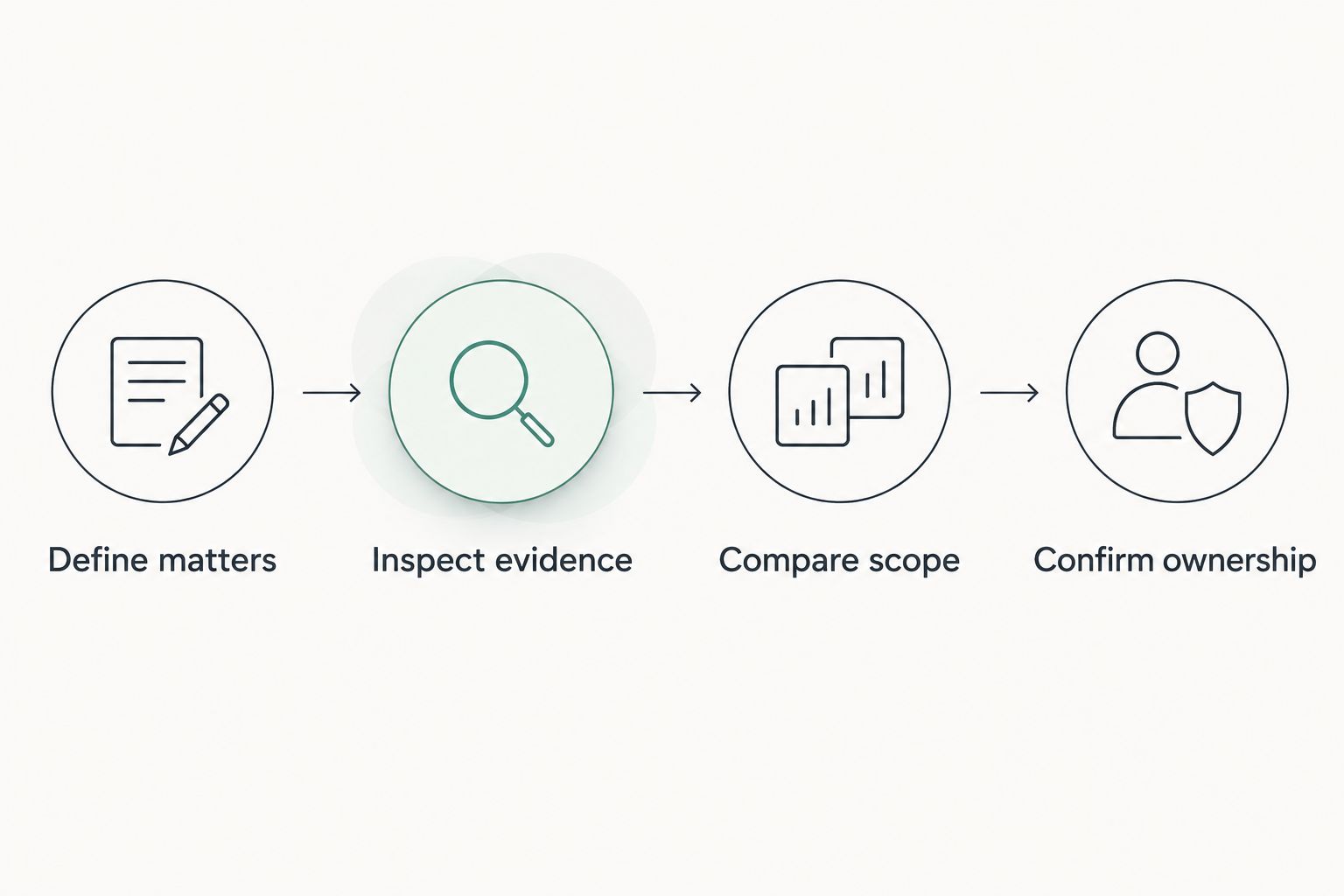
Organize the buying process around these four stages:
- Define matters: List accepted case types, excluded matters, jurisdictions, and intake constraints.
- Inspect evidence: Request relevant work examples and ask what each example actually demonstrates.
- Compare scope: Match deliverables, ownership, review responsibilities, and reporting definitions.
- Confirm ownership: Document access rights, export arrangements, and exit responsibilities before signing.
Make the requested evidence concrete. Ask a shortlisted provider to walk through 3 practice-area pages and explain the intended reader, search purpose, and next action on each. This is a recommended review exercise, not a performance benchmark.
Request a proposed 90-day work plan with dependencies clearly marked. The purpose is to expose sequencing and responsibilities, not to demand a guaranteed ranking by a deadline.
Finally, ask the provider to demonstrate 1 inquiry path from landing page to intake record. Check where attribution stops and who records whether the inquiry fits your practice.
Separate activity from business outcomes
A published page is a deliverable. A search impression is exposure. A retained matter is a business outcome. Your report should not treat them as interchangeable.
Useful reporting connects the work performed with relevant search visibility, website behavior, and intake results where measurement allows. Keep confidential case details out of routine marketing reports, and agree with counsel on appropriate information handling.
How this shortlist is ranked
These recommendations rank service-model fit, not measured agency performance. Rankings.io occupies the personal-injury specialist slot; Justia occupies the legal directory and marketing slot; the broader small-business agency occupies the coordinated-services slot.
The criteria are practice fit, scope clarity, content review, inquiry measurement, and account ownership. No ranking here implies a verified lead total, client-retention rate, or comparative search result.
For your 2026 decision, treat public positioning as the entrance requirement. The proposed engagement must supply the detail needed to make the final choice.
Which SEO company should your law firm choose?
Default to the narrowest service model that fully addresses your current problem. A personal-injury firm seeking a specialist should begin with Rankings.io. A firm deliberately evaluating directories alongside website marketing should examine Justia.
Choose a broader small-business agency when the website, brand presentation, and marketing coordination need attention together. Do not add channels simply because they appear in a service menu.
Before signing, confirm these points in writing:
- The matters and jurisdictions the campaign targets.
- The work included and the work excluded.
- The attorney responsible for reviewing legal content.
- The accounts and assets your firm controls.
- The definition of a qualified inquiry.
- The process for ending the engagement and transferring access.
If a proposal remains vague after those questions, hold the purchase. The next move is a clearer scope, not a longer contract.
FAQ
What's the best SEO company for a personal-injury law firm?
Rankings.io is the specialist shortlist choice in this comparison because its positioning focuses on personal-injury firms. Confirm relevant work, geographic conflicts, account ownership, and the proposed scope before choosing it.
Is a legal SEO specialist better than a general marketing agency?
A legal specialist is the more direct fit when practice-specific experience is your main selection requirement. A broader agency fits a different brief when website design and multiple marketing services need coordination.
Should my law firm consider Justia for SEO?
Consider Justia when you want to evaluate legal directory participation alongside website marketing. Require separate explanations of directory activity, work on your own website, and inquiry attribution.
What should a law-firm SEO proposal include in 2026?
A law-firm SEO proposal should define target matters, jurisdictions, deliverables, attorney review, reporting, and account ownership. It should also explain dependencies and what transfers to your firm when the engagement ends.
Can an SEO company guarantee that my firm will rank first?
An SEO company cannot guarantee a particular organic Google ranking. Evaluate the proposed work and measurement plan rather than accepting a ranking promise as evidence of quality.
How do I know whether SEO inquiries are useful?
Compare inquiries with your firm's accepted matters and intake criteria. Record qualified prospects and retained matters separately from total calls and form submissions.
Does my attorney need to review SEO content?
Assign an attorney to review legal accuracy, jurisdictional relevance, and advertising compliance before publication. The agency can prepare content, but your firm needs a defined approval responsibility.
One last thing
Ask each finalist to identify a page your firm should not publish. The answer forces a discussion about excluded matters, overlapping topics, and geographic relevance instead of rewarding the largest content list.
A useful SEO plan includes boundaries. Choose the provider that can explain what belongs in your campaign, what does not, and how that distinction supports your intake priorities.